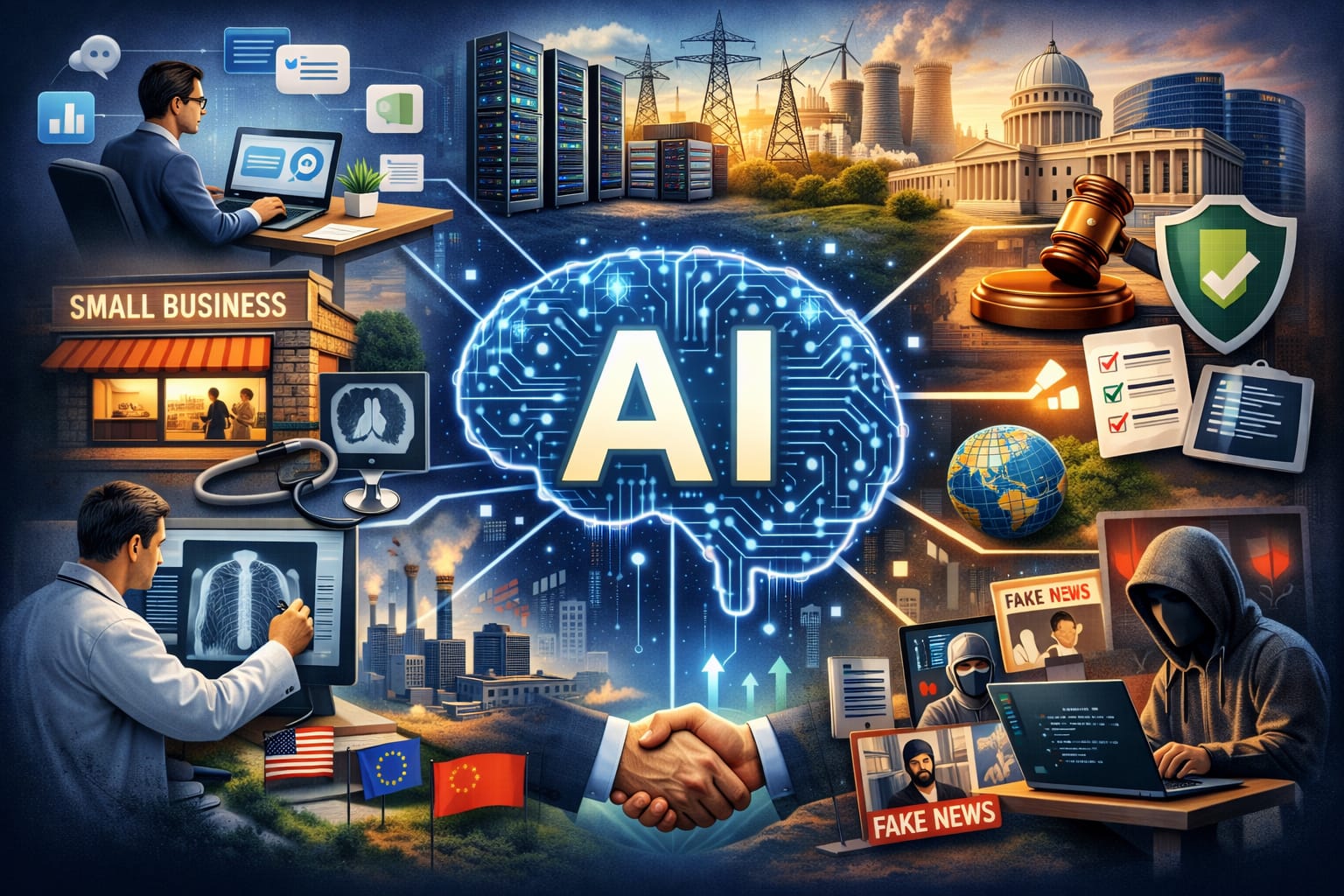
AI isn’t “coming someday.” It’s already reshaping how we work, how companies invest, how governments regulate technology, and how critical systems like healthcare and energy are run. The most important change isn’t that AI can do new tricks—it’s that AI is becoming infrastructure: embedded into everyday tools, business processes, and national strategies.
Below is a grounded snapshot of what’s changing right now—with the biggest real-world shifts (and the trade-offs that come with them).
1) Work is being reorganized around “AI-assisted tasks”
Across many office and knowledge roles, the immediate impact of generative AI is task acceleration: drafting, summarizing, translating, coding, customer support responses, research synthesis, and document preparation.
Experimental and field evidence reviewed by the OECD shows measurable productivity gains in common text/code-heavy tasks—often in the single digits up to 25%+ depending on the task and context.
Stanford’s AI Index also summarizes a growing body of research indicating AI can boost productivity and sometimes narrow skill gaps (e.g., helping less-experienced workers perform closer to experts on certain tasks).
What this changes in practice
- Teams move faster with fewer handoffs (one person can “do the first draft” of many things).
- The bottleneck shifts from writing to judgment: verifying, editing, setting direction, and integrating domain context.
- New “AI literacy” becomes a baseline job skill (prompting, verification, safe use).
2) Small businesses are adopting AI—but unevenly
AI adoption is no longer just Big Tech. SMEs are starting to use LLMs for text generation, marketing content, and visual assets—but adoption varies by country and industry.
An OECD report on generative AI and SMEs highlights early adoption statistics from official surveys (e.g., usage rates in the UK and Canada, and cross-country differences in Europe).
What this changes in practice
- A small company can produce “enterprise-looking” content and support faster than before.
- Competitive advantage increasingly comes from workflow design (how you integrate AI) rather than “having AI.”
3) Healthcare AI is moving from pilots to regulated tools
In healthcare, the shift is from AI as research to AI as regulated clinical support (especially in imaging, triage, and diagnostic assistance).
The US FDA maintains public information on AI-enabled medical devices and actively supports safe innovation in this category.
A 2025 NCBI (NIH) book chapter notes that as of August 2024, the FDA had authorized roughly ~950 AI/ML medical devices, with heavy concentration in specialties like radiology and cardiology.
What this changes in practice
- Hospitals can speed up detection of certain conditions (especially in imaging workflows).
- Real-world performance, bias, and monitoring become central—because deployment at scale is where risks show up.
4) AI is driving a massive new wave of energy + data center buildout
One of the least visible (but most consequential) changes: AI is accelerating investment in data centers, grid capacity, and power generation.
The IEA projects data center electricity consumption growth around ~15% per year from 2024–2030 and expects global data center electricity use to roughly double by 2030 (base case).
In the IEA’s World Energy Outlook 2025 executive summary, investment in data centres is expected to reach about USD 580B in 2025.
This isn’t abstract: regulators and utilities are already approving major generation expansions to meet data center demand. For example, Georgia regulators approved a large electricity generation increase plan tied heavily to data centers.
What this changes in practice
- “AI progress” becomes linked to power availability, grid reliability, water use, and local permitting.
- Communities and governments face trade-offs: jobs and investment vs. environmental and ratepayer risk.
5) Regulation is shifting from “principles” to enforceable timelines
Governments are translating AI concerns into enforceable rules—especially around transparency, safety, and high-risk use cases.
The European Commission’s AI Act timeline specifies that the Act entered into force 1 August 2024, with staged application dates (including prohibited practices and AI literacy obligations applying from 2 February 2025, and obligations for general-purpose AI models applying from 2 August 2025).
What this changes in practice
- Companies must treat AI compliance like privacy/security compliance—documented processes, vendor controls, risk classification.
- “Move fast and break things” becomes harder when AI touches hiring, finance, healthcare, or critical infrastructure.
6) AI is reshaping global competition and national investment strategy
AI investment is becoming geopolitical and industrial-policy driven: countries want talent, compute, and local ecosystems.
A late-December 2025 report describes how major US tech firms pledged large AI-related investments in India, aimed at data centers and AI adoption—along with concerns about sustainability, resources, and workforce impact.
What this changes in practice
- AI becomes a “strategic sector” like energy or semiconductors.
- The winners aren’t only the best model-builders; they’re also the best builders of ecosystems (power + data + skills + regulation + infrastructure).
7) The risks are scaling too: misinformation, privacy leakage, and security
As AI becomes normal, the downside isn’t hypothetical:
- Synthetic content makes scams and misinformation cheaper to produce.
- Sensitive data can leak through poorly governed tools and plugins.
- Security teams now defend both systems and “human workflows” that rely on AI outputs.
This is why so many organizations are building policies around:
- what data can be entered into AI tools,
- how outputs must be verified,
- and which vendors meet security standards.
The big picture: AI is becoming invisible—because it’s becoming default
The most important “right now” change isn’t a single killer app. It’s that AI is being woven into:
- everyday productivity software,
- regulated healthcare devices,
- SME operations,
- national infrastructure planning,
- and legal compliance frameworks.
The organizations that will benefit most are the ones that treat AI like a system: people + process + tools + governance—not a magic button.